
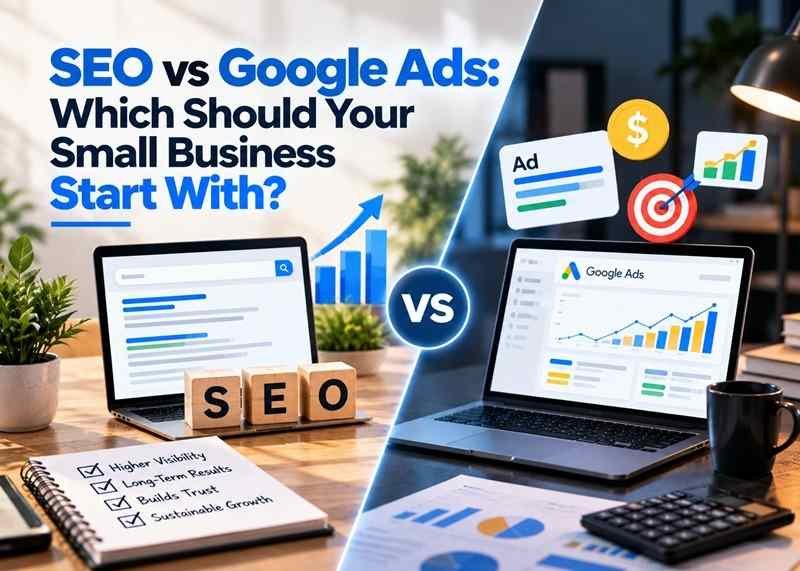
You want more customers to find your business, but your marketing budget has limits. Should you invest in search engine optimisation or start paying for Google Ads?
Google Search Ads can help you test existing search demand sooner. SEO develops your organic search presence over time. The better starting point depends on your cash flow, website, competition and ability to turn enquiries into customers.
For an Australian small business, the decision should start with a practical question: which channel can you support properly, measure accurately and improve consistently?
This guide compares SEO primarily with Google Search advertising. Google Ads also includes other formats, such as video and display advertising, which serve different purposes.
What Is the Difference Between SEO and Google Ads?
SEO helps search engines understand your website and helps customers find useful information through unpaid search results. It can involve technical improvements, service pages, helpful content, internal links and accurate local business information.
Google does not charge you for an organic search click. However, the research, writing, development and ongoing work involved in SEO still require time or money.
Google Search Ads allow your business to compete for advertising placements when relevant searches happen. Advertisers commonly pay when someone clicks their Search ad.
Your bid is one factor in whether an ad appears. Ad quality, relevance, the landing page and the circumstances of the search also influence the auction. Paying more does not automatically secure the best position.
| Consideration | SEO | Google Search Ads |
|---|---|---|
| Where you appear | Organic search results; local visibility may also be relevant | Eligible advertising placements |
| How costs work | Website, content, technical work and ongoing maintenance | Advertising spend, plus management and website costs where applicable |
| Speed of visibility | Changes need time to be discovered and assessed | Eligible campaigns can compete for placements once approved and active |
| Control | You influence your website; Google determines rankings | You control campaign settings and budgets; auctions determine delivery |
| If you pause spending | Existing pages may continue attracting visitors, but performance can change | Paid visibility from the paused campaigns stops |
| Main measurement | Relevant organic enquiries, sales and acquisition costs | Relevant paid enquiries, sales and acquisition costs |
Neither channel guarantees customers. Both depend on your offer, website experience and sales process.
When Google Ads May Be the Better Starting Point
Google Search Ads can be a sensible first investment when customers already search for your service and you need to evaluate that demand sooner.
Imagine a repair business introducing a service in an area it already covers. A focused campaign can direct relevant searches to a page explaining the service, availability and enquiry options.
That is a useful test only if the business can answer calls, assess jobs and deliver the work.
Consider starting with Google Ads when:
- You have a clearly defined service or product to promote.
- Relevant searches exist in your intended locations.
- You can fund a meaningful test, including setup and management where needed.
- Your website explains the offer and makes contacting you straightforward.
- Someone can respond promptly to enquiries.
- You can measure lead quality and completed sales.
Campaigns need review after launch. Search relevance, enquiry quality and customer acquisition costs matter more than collecting clicks.
When to fix the basics first
Advertising is difficult to assess if your contact form fails, your phone number is incorrect or your landing page leaves customers uncertain about what you offer. Before increasing traffic, check the experience visitors will actually receive -- clear calls to action, working enquiry forms and accurate contact details all affect how many clicks turn into real enquiries.
When SEO May Be the Better Starting Point
SEO can be the stronger initial priority when your business can invest over time and your website has clear opportunities to answer relevant customer searches.
For example, an established service business might have repeat customers and steady referrals, but only one short page describing several different services. Developing clearer service information could help both existing visitors and people discovering the business through search.
Consider prioritising SEO when:
- You have enough existing business to support a longer development period.
- Customers regularly research your services before making contact.
- Your website lacks useful pages for important services or products.
- Technical issues make the site difficult to access or understand.
- You can contribute genuine expertise, project examples and customer information.
- You want to develop an additional source of enquiries alongside paid campaigns or referrals.
There is no universal deadline for SEO results. Changes can take anything from hours to several months to be reflected, and not every change produces a noticeable improvement. Your starting position and competition matter.
Our SEO services bring technical, content and local search work into a plan shaped around your business.
What If Your Budget Is Small?
A small budget makes focus especially important.
Splitting limited resources between several campaigns and an extensive SEO programme can leave every activity underfunded. Choose an initial priority, while keeping essential website and measurement work in place.
For a Search advertising test, narrow the scope to a service, audience and geographic area you can realistically serve. Agree on the test budget and what evidence will guide the next decision.
For an SEO programme, identify the most important obstacles and commercial pages first. Improving an existing service page may be more useful than immediately publishing a large collection of general blog posts.
Also consider whether people search for your offer at all. A new or unfamiliar product may need introductions through partnerships, outreach or other advertising channels before search becomes a substantial source of customers.
Compare Customer Acquisition Costs, Not Just Click Prices
A cheap click is useful only if it contributes to a worthwhile business outcome.
For either channel, follow the journey: Visitor → enquiry → qualified enquiry → paying customer.
A qualified enquiry should fit your services, location and customer requirements. A phone-button click or WhatsApp-button click indicates contact intent, but does not prove that a conversation or sale occurred.
Consider this hypothetical advertising example:
| Item | Illustrative amount |
|---|---|
| Advertising spend | A$1,000 |
| Campaign management | A$500 |
| Total marketing cost for the period | A$1,500 |
| Qualified enquiries | 25 |
| New paying customers attributed to those enquiries | 5 |
| Cost per qualified enquiry | A$60 |
| Customer acquisition cost | A$300 |
These are invented figures to explain the calculation, not W&S pricing or industry benchmarks. Any additional landing-page, creative or tracking costs would also need to be accounted for.
Whether A$300 per customer is sustainable depends on what remains after delivering the product or service, repeat business and other operating costs.
Apply the same discipline to SEO. Include the cost of content, technical work and management, and evaluate outcomes over a period appropriate to the work and your sales cycle. Use consistent attribution methods rather than crediting both channels with the same sale.
When Using Both Makes Sense
SEO and Google Ads can work alongside each other when the budget and business capacity support both.
You might use Search advertising to test demand for a particular service while improving the website's broader organic visibility. Useful landing-page content, clearer enquiry options and better measurement can support both activities.
Advertising can also reveal questions and language worth investigating through content research. However, a search that performs well in an advertising campaign does not automatically become an easy organic ranking opportunity.
Paying for Google Ads does not improve your organic rankings -- Google keeps advertising separate from inclusion and ranking in organic search results.
If you choose both channels, give each a defined role. Agree on which services each supports, how budgets are allocated and how results will be reviewed.
A Practical Way to Choose Your Starting Point
Before committing to a proposal, work through these five questions.
1. What business outcome do you need?
Be specific. "More quote requests for commercial cleaning in our service area" gives you a clearer direction than "more website traffic".
2. How urgently do you need to evaluate demand?
Search advertising may help you test sooner, provided there is relevant demand and a suitable budget. SEO usually needs a longer assessment period.
3. Can your website and team handle the opportunity?
Check service information, mobile usability, enquiry forms and response arrangements. Match your promotion to the work you can actually deliver.
4. What can you afford to learn?
Allow for more than advertising spend or an agency fee. Consider website improvements, content, tracking and the time needed to follow up enquiries.
5. What would justify continuing?
Agree on measures such as qualified enquiries, acquisition cost and completed sales. Review poor search relevance or broken tracking promptly, while allowing enough time and data to evaluate genuine business outcomes.
A useful proposal should explain these decisions and the assumptions behind them.
Frequently Asked Questions
Is SEO cheaper than Google Ads?
SEO has no Google advertising charge for organic clicks, but it still requires work. Its total cost depends on your website and competition. Compare acquisition costs and lead quality over a suitable period rather than assuming either channel is always cheaper.
Can a new business start with Google Ads?
Yes, if it has a clear offer, a usable website, relevant search demand and the budget to test. A new campaign still needs accurate measurement and review; launching it does not guarantee enquiries.
Should I stop SEO when I start advertising?
Make that decision around your priorities and resources. Advertising does not replace essential website maintenance or accurate service information. Businesses with sufficient capacity may benefit from developing organic visibility while running focused paid campaigns.
Choose a Starting Point Around Your Business
W&S Digital Marketing can review your website, services and current visibility to help you identify practical priorities.
Whether you need Google Ads management, SEO or improvements to your enquiry journey, the starting point should reflect your customers, budget and business goals.