
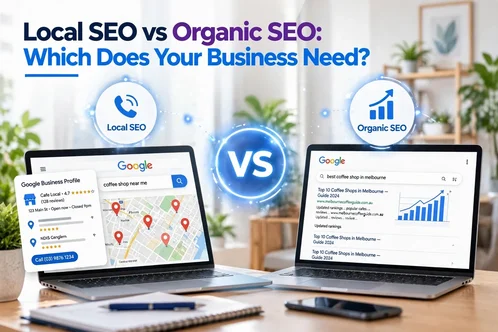
If your customers find you in person or within a set service area, start with local SEO. If they buy from you online or from anywhere in the country, start with organic SEO. Most growing Australian businesses need both, but the order matters. Local SEO wins the work near you first. Organic SEO then widens the net.
This guide explains the difference in plain terms, shows where each one makes you appear, and gives you a simple way to decide where your next dollar should go.
The Quick Answer: Local SEO, Organic SEO, or Both?
Local SEO helps you appear in Google Maps and the local pack when nearby customers search for a service. Organic SEO helps your website rank in the regular search results, often across a city, a state or the whole country.
The difference between local and organic SEO is not the search engine. It is the intent behind the search. A local search signals that someone wants a business they can call, visit or book soon. A broader organic search often signals research, comparison or an online purchase.
- Choose local SEO first if you serve one area and your jobs come from calls, visits and bookings.
- Choose organic SEO first if you sell online or serve customers across many regions.
- Choose both if you rely on local work today but want to grow into new areas or online sales.
Whichever you choose first, your website and your Google Business Profile need to tell the same story.
What Is Local SEO?
Local SEO is the work that helps your business appear when people search for a service in a specific place. Think of searches such as plumber near me, dentist in Parramatta or emergency electrician Blacktown. Google answers these searches with a map and a short list of businesses, known as the local pack, before the regular website results.
Your Google Business Profile sits at the centre of local SEO. It is the free listing that shows your name, category, phone number, opening hours, photos and reviews on Google Search and Maps. When that profile is complete and accurate, a customer can call you or request directions without ever visiting your website.
Where Local SEO Makes You Appear
- In Google Maps results on phones and desktops.
- In the local pack, the map and three business listings shown for local searches.
- In near me searches, where Google uses the searcher's location as the area.
- In voice searches where people ask for a nearby service out loud.
Google says local results are based mainly on relevance, distance and prominence. Relevance is how well your profile matches the search. Distance is how close your business is to the searcher. Prominence covers reviews, ratings and how well known your business is online. No agency can control all three. What you can control is the accuracy and completeness of the information Google works from.
What Local SEO Work Includes
- Setting up and fully completing your Google Business Profile with the right categories and services.
- Keeping your business name, address and phone number consistent on your website and across directories.
- Earning genuine Google reviews and replying to them.
- Adding clear service and location pages to your website for the areas you actually cover.
- Adding photos, opening hours and service details, then keeping them current.
If your profile is set up but you still do not appear on the map, work through the checks in our guide on why your business is not showing on Google Maps before you spend anything on advertising. Verification problems, a wrong category or a service area set too wide are common causes.
What Is Organic SEO?
Organic SEO is the work that helps your website pages rank in the unpaid search results for the terms your customers type into Google. These are the standard blue link results that appear below the ads and, for many searches, below the map results. A page ranks because Google sees it as a relevant and trustworthy answer, not because the business paid for the click.
Organic SEO is not limited by distance. A well built page can attract visitors from your whole city, your state or the entire country. That is why it suits online stores, national services and any business whose customers research online before they buy.
Where Organic SEO Makes You Appear
- In the regular unpaid results for service, product and information searches.
- In featured snippets and AI generated answers that quote clear, well structured pages.
- In image and video results when your content matches the search.
- For searches with no location at all, such as how to unblock a drain or best accounting software for tradies.
What Organic SEO Work Includes
- Technical fixes so Google can crawl, index and load your pages properly.
- Service and product pages that answer real customer questions in full.
- Helpful blog content that covers the topics your customers research before buying.
- Internal links that connect related pages and show how your site is organised.
- Relevant mentions and links from other trusted websites.
In practice, most businesses buy these tasks as one programme. Our SEO services combine technical work, content and local optimisation, because a page that loads slowly or answers the wrong question will struggle no matter how strong the rest of the site is.
Local SEO vs Organic SEO at a Glance
Business owners often frame the choice as local SEO vs SEO in general, as if one replaces the other. The table below puts them side by side.
| Factor | Local SEO | Organic SEO |
|---|---|---|
| Main goal | Win customers in a defined local area | Win visitors and customers from search at any distance |
| Where you appear | Google Maps and the local pack | The regular unpaid search results |
| Main asset | Your Google Business Profile, supported by your website | Your website pages and content |
| Typical searches | Plumber near me, cafe in Surry Hills, dentist open now | Best plumber for hot water systems, how much does a website cost, buy dog food online |
| Key signals | Profile completeness, reviews, distance, consistent business details | Content quality, technical health, page relevance, links from other sites |
| Best suited to | Tradies, clinics, cafes, salons, repair services and local professionals | Online stores, national services, franchises and information led brands |
| How success shows up | Calls, direction requests, bookings and profile views | Organic visits, enquiries, online sales and content engagement |
| Geographic limit | Strong within the area you genuinely serve | Can reach a city, a state, the country or overseas |
How the Difference Plays Out in a Real Search
Imagine two people searching on the same afternoon. The first types fridge repair near me into a phone. That person has a fridge full of food and wants someone today. Google shows the map results first, and the businesses with complete profiles, strong reviews and a location close to the searcher get the calls.
The second person types how to choose a fridge repair company or searches for a spare part to buy online. There is no single right suburb for that answer. Google shows articles, guides and product pages from across the country. Organic SEO decides which websites earn those clicks.
Many businesses need to be found in both moments. In our own client work with Sydney appliance repair businesses, the two channels regularly produce results side by side. One repair client grew organic clicks from 40 to 524 over a six month comparison period, while its Google Business Profile recorded 425 interactions in the same period, including 79 phone calls. The profile captured people ready to book. The website captured people still comparing options. Neither channel alone would have produced the full picture.
This is also why measurement matters. Google Business Profiles generate interactions and direct phone calls that rarely show up in a standard website traffic report, so a business that only watches website visits can easily undervalue its local presence.
Local SEO vs National SEO: When You Outgrow One Area
As a business grows, the question often shifts from local or organic to local SEO vs national SEO. National SEO is organic SEO aimed at a whole country rather than one area. It relies on strong service pages, in depth content and authority signals, because you no longer have the advantage of being close to the searcher.
Think of coverage as a scale. At one end sits a single suburb focus. At the other end sits the local vs global SEO question faced by brands that sell in several countries. Most Australian small businesses sit between those points. They serve one city well and want the next city, or they sell online within Australia only.
The practical rule is simple. Expand your targeting only as fast as you expand your ability to deliver. A location page for a suburb you cannot reach within a reasonable time creates enquiries your team cannot serve well. For most owners, choosing between local SEO and national SEO for small business growth comes down to where the next job will actually be done. If the answer is within driving distance, local work still deserves the budget. If the answer is wherever the courier delivers, organic and national work moves to the front of the queue.
Which One Does Your Business Need? A Decision Framework
Work through the three groups below. Most businesses recognise themselves in one of them within a minute.
Start With Local SEO If
- Customers visit your premises or you travel to theirs within a set area.
- Your best jobs start with a phone call, a booking or a walk in visit.
- You compete with businesses in nearby suburbs more than with national brands.
- Your Google Business Profile is incomplete, unverified or short on reviews.
- You have one location, or a small number of locations, and want each one busier.
A workshop is a clear example. Our guide to local SEO for mechanics shows how a single suburban workshop uses its profile, reviews and service pages to win work from drivers nearby, rather than trying to rank across the whole state.
Start With Organic SEO If
- You sell products or services online and location does not limit delivery.
- Customers research for days or weeks before they contact anyone.
- Your competitors are national brands or content rich websites, not nearby shops.
- You already have steady local work and want a new growth channel.
- Your website has thin service pages or technical problems holding it back.
Plan for Both If
- You run several locations or cover a wide service area across a city.
- You take local bookings and also sell products or bookings online.
- You plan to open in a new area within the next year.
- Your local profile already performs well but website enquiries are weak, or the reverse.
| Business type | Start with | Why | Add next |
|---|---|---|---|
| Tradie or repair service, one area | Local SEO | Jobs come from nearby calls and Maps results carry high intent | Service pages for each core service you offer |
| Cafe, salon or local retail | Local SEO | Customers choose based on distance, hours and reviews | Content that answers local questions and promotes events |
| Clinic or professional firm | Local SEO, then organic | Trust and proximity drive bookings, research drives comparisons | Guides that answer client questions in your field |
| Online store | Organic SEO | Buyers search by product and problem, not by suburb | Local work only if you add a physical store or pickup point |
| Multi location business | Both together | Each location needs a profile, and the website must tie them together | Location pages with unique detail for every site |
| National service or software | Organic SEO | Distance gives you no advantage, so content and authority decide | Digital PR and partnerships to earn stronger mentions |
How Local and Organic SEO Work Together
The two approaches share the same foundations, which is why sequencing them usually beats choosing one forever. A fast, clear website helps both. Your profile links to your website, and a strong service page gives profile visitors a reason to book. Reviews earned through local work also build trust before a click.
Content plays both sides as well. A guide written to answer a research question can rank nationally, yet still mention your service area and link to your booking page. A location page written for one suburb supports your profile for that area and adds depth to your overall site.
Start with a shared checklist before you split the budget:
- Fix technical problems, slow pages and broken enquiry forms first.
- Write one clear page for each core service, in plain language.
- Complete your Google Business Profile and check it against your website details.
- Set up call and enquiry tracking so you can see which channel produces work.
- Then direct the remaining budget to the channel your customers use most.
If you are unsure where to begin, our breakdown of the five local SEO wins every small business should make covers the profile and website fixes that support both channels at once.
What Each One Costs and How Long It Takes
Local SEO usually needs a narrower scope at the start. The early work centres on your profile, your reviews, your directory details and a handful of key pages. Organic SEO usually needs more content and more technical work, so the scope and the budget tend to be larger. Neither is free. Both trade money, time or a mix of the two.
On timing, expect local profile improvements to show movement sooner than broad organic rankings. Correcting a category, adding services and building a steady flow of reviews can lift profile actions within weeks. Stronger Maps positions and competitive organic rankings usually take months of consistent work.
Rather than compare monthly prices, compare cost per enquiry. A cheaper programme that produces no calls is expensive. A larger programme that fills your booking calendar can be good value. Our guide on whether SEO is worth it for a small business walks through the break even maths using your own job value and margin, and our SEO cost guide for Australia explains what influences pricing. For a side by side look at paid search, see our SEO vs Google Ads comparison.
Common Mistakes When Choosing Between the Two
- Relying on Maps alone with no website, which leaves research driven customers with nothing to read.
- Building dozens of near identical suburb pages instead of a few strong pages for areas you truly serve.
- Chasing national rankings while your profile still has the wrong phone number or opening hours.
- Ignoring reviews, then wondering why a closer competitor with more reviews wins the call.
- Judging SEO after four weeks and stopping just as the early work starts to compound.
- Measuring only website traffic and missing the calls and direction requests your profile produces.
A Simple 90 Day Starting Plan
You do not need to do everything at once. This sequence suits most local service businesses and can be adapted for online sellers by swapping the profile steps for product and category page work.
- Days 1 to 30: Claim and complete your Google Business Profile. Fix your website contact details, service pages and enquiry forms. Set up call tracking.
- Days 31 to 60: Publish or improve one page per core service. Ask recent happy customers for reviews and reply to every review you receive.
- Days 61 to 90: Add helpful content that answers the questions customers ask before booking. Review which searches and pages produced enquiries, then plan the next quarter around that evidence.
How to Tell Whether Your Choice Is Working
| Channel | Watch these numbers | Where to find them |
|---|---|---|
| Local SEO | Phone calls, direction requests, profile views and review growth | Google Business Profile performance report |
| Organic SEO | Organic clicks, enquiries from service pages and rankings for core terms | Google Search Console and your website analytics |
| Both together | Total enquiries, cost per enquiry and jobs booked | Your booking system or CRM, matched against the reports above |
Review the numbers monthly, not daily. Rankings move around in the short term. A steady rise in calls and enquiries over a quarter tells you far more than a single position change on one keyword.
Making the Right Choice for Your Business
Local SEO puts you in front of nearby customers who are ready to act. Organic SEO puts your website in front of a much wider audience, including people who are still researching. The right starting point is the one that matches how your customers actually find and choose you today.
If you want a second opinion on where your business should start, W&S Digital Marketing can review your profile, your website and your current search visibility, then recommend a practical order of work. Get in touch to talk through your options, or explore our SEO services to see how we approach both channels.
Frequently Asked Questions
Can I do local SEO without a website?
Yes, you can start with a Google Business Profile on its own, and many small businesses do. The profile can bring calls and direction requests from Maps. A website still matters because it gives customers service details, builds trust and supports bookings. In practice, the two work best together over time.
Is local SEO part of organic SEO?
Local SEO sits inside the wider organic SEO umbrella because both rely on unpaid search visibility. The difference is focus. Local SEO targets searches with a place or near me intent and leans on your profile, reviews and location pages. Organic SEO targets website rankings across a broader market.
How long does local SEO take compared with organic SEO?
Profile fixes and review growth can improve local visibility within weeks, although stronger Maps positions usually take a few months. Organic rankings for competitive service pages often need several months of content and technical work. Timelines depend on competition, your starting point and how consistently the work is done.
Which is cheaper, local SEO or organic SEO?
Neither is always cheaper. Local SEO often costs less at the start because the scope is narrower and centres on your profile, reviews and key location pages. Organic SEO usually needs more content and technical work, so budgets tend to be larger. Judge both on cost per enquiry, not monthly price alone.
Do I need national SEO if I plan to expand to new cities?
Not straight away. A practical path is to win your home area first, then build location pages and organic content for each new city as you genuinely start serving it. Expanding before you can deliver the service in that area usually wastes budget and creates enquiries your team cannot handle well.